Letters
There are two letters in the archives of the Jewish Museum; one addressed to Sigmund and the other is about Sigmund. The first letter is written in draft and signed with the letters E W, Elly Weijl. She was Sigmund's secretary in Amsterdam.
In this letter, addressed to Mr. Sigmund, it states that Joop [de Nooij] has passed on instructions. She further writes: Everything is going smoothly at Sio's, and Your affairs will be handled in Your spirit to the best of my ability.
The letter was possibly drafted during the time the Sigmund family was imprisoned in Westerbork.
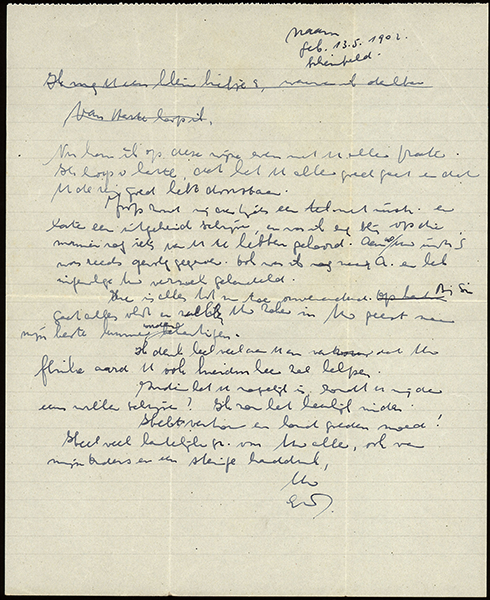
The full text is at the bottom of this page.
Departure from Westerbork
This letter is a deeply moving live account of what the letter writer experienced during the departure of the Sigmund family to Auschwitz. She describes it in an empathetic, cinematic way. It is as if you were there yourself.
I went up to him and gave my name. He shook my hand; quite long and silently, I led him to the compartment where his wife and children were sitting.
When the train started moving, I sought out the compartment, shook her hand, and waved goodbye.
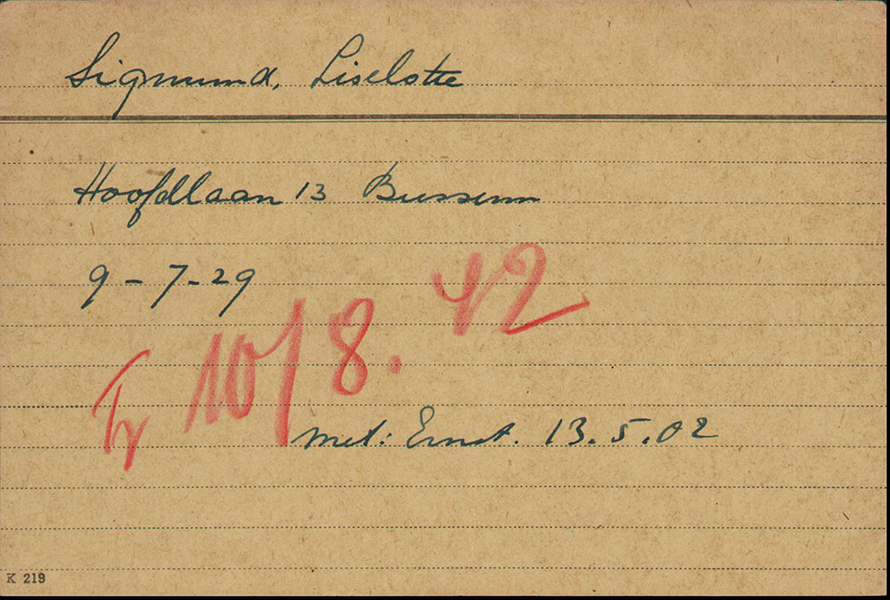
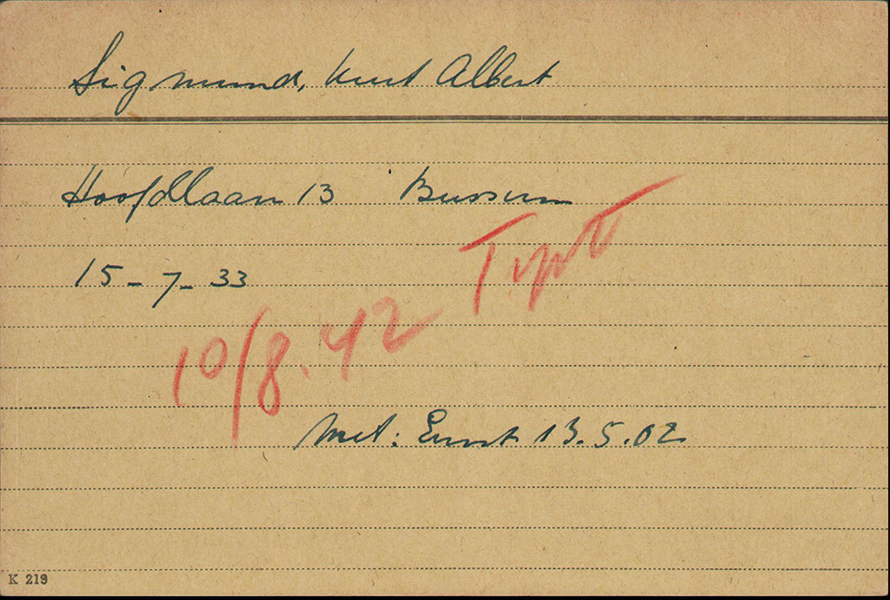
The transport that took the Sigmund family to Auschwitz was on August 10, 1942, arrived at Auschwitz August 12.
Käthe, Lotte, and Kurt were murdered in the gas chambers upon arrival. Ernst Sigmund died three weeks later, on September 4, 1942, of pleuropneumonia.
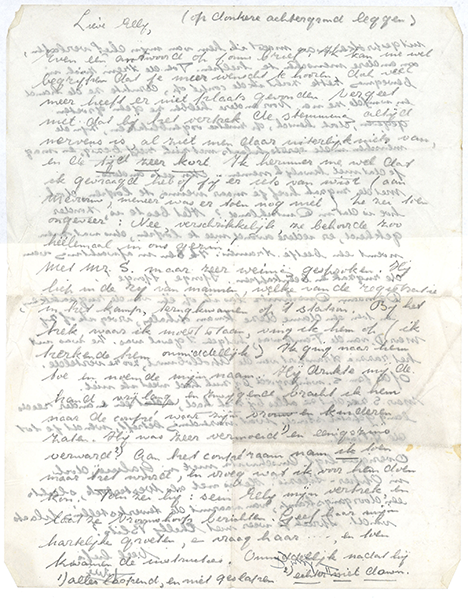
The full text is at the bottom of this page.
Transport August 10, 1942
The letter to Elly Weijl states that the Sigmund family took seats in a train compartment. An employee of Camp Westerbork writes about this transport:
At that time, ordinary trains were still used for the transports, not cattle wagons. That was not until March 1943. The train also did not yet depart from the camp, but from the station in Hooghalen. The railway line to the camp was still under construction at that time and was put into service in November.
Hence the remark that he was tired because he was returning from registration at the camp. It is therefore possible that the family was in Westerbork for only a very short time, if they were not transported directly from Rotterdam to Auschwitz with a brief stopover.
According to the Kalendarium der Ereignisse in Auschwitz-Birkenau, a total of 559 people arrived with this transport of the RSHA Holland from Westerbork on August 11, 1942; 288 men and 271 women. Of these, 164 men and 131 women were selected. The remaining 264 were sent to the gas chambers. chambers.
Jewish Council Card Index
The Jewish Council Card Index was compiled during the Second World War by various departments of the Jewish Council in Amsterdam. A Jewish Council Card Index card contains personal information, and often family members are also listed on the card. Additionally, it contains information regarding any 'sperre,' an exemption from deportation.
After the Second World War, the deportation date was written down in red pencil by the Red Cross. Currently, the card index is physically located at the National Holocaust Museum and is digitally available via Arolsen Archives and oorlogsbronnen.nl. [text:oorlogsbronnen.nl]
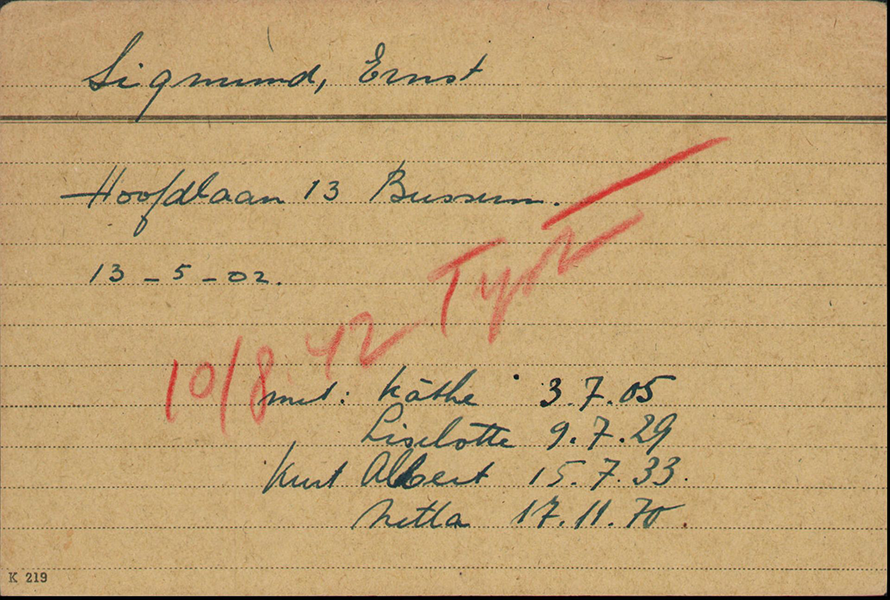
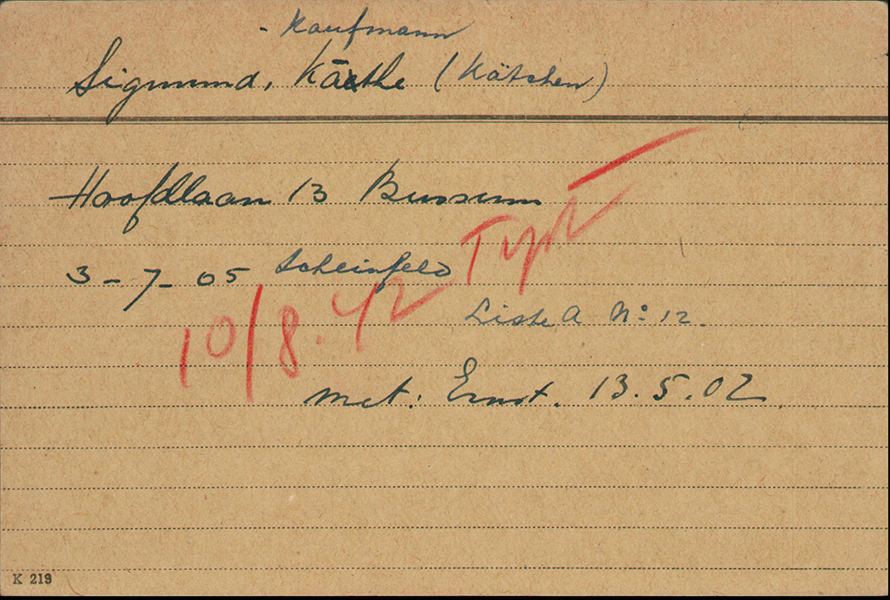
Name
born 13. 5. 1902
Scheinfeld
Now I can speak with you all for a moment in this way.
I sincerely hope that you are all doing well and that
you have endured the journey well.
Joop sent me . . . . . . . . . . a telephone with instr. (instructions?) and
later an extensive letter, and I was very happy to have heard something from you in that
way. Your instru's (?)
had already been followed. I was also still very A. and have acted
in accordance with your request.
Here everything remains unchanged up to now. At Sio's everything is going smoothly and your affairs will be handled in your spirit to the
best of my ability.
I think of you very much and trust that your
strong nature will help you both . .
If it is possible for you, would you please
write to me sometime? I would love that.
Have faith and keep up the spirits!
Warm regards to you all, also from
my parents and a firm handshake,
Yours
EW
Dear Elly, (place on dark background)
Just a quick reply to your letter. I can now understand
that you wish to hear more, that much
more has not taken place. Do not forget
that the atmosphere at departure is always
nervous, even if one sees nothing of it outwardly,
and time is very short. I do remember
that I asked if you knew anything about it (to
the lady, the gentleman was not there at the time). She said
something like: No, terrible, she belonged so
completely in our family!
I spoke very little with Mr. S. He
walked in the line of men returning from the registration
in the camp, or the station. At the
gate, where I had to stand, I caught up with him (I
recognized him immediately). I went
up to him and gave my name. He shook my
hand; quite long and silently, I led him
to the compartment where his wife and children
were sitting. He was very tired 1) and somewhat
confused 2). At the compartment window I then took the floor,
and asked what I could do for him.
Then he said: signal Elly my departure,
and have her notify Vroomhoop. Give her my
warm regards, and ask her . . . ., and then
the authorities arrived.
Immediately after he
1) had finished walking, and
2) however not down
had finished speaking,
I had to leave him on orders from my boss,
to help other people.
When the train started moving,
I sought out the compartment, shook their hand
and waved goodbye.
They didn't give greetings to others,
but really, at such moments,
people are primarily
concerned with themselves, and
you shouldn't blame them for that.
Now something else.
with a backpack you don't have to walk much, but
how is that in Germany? It is best, no joke, to walk with it every evening, so what they call a bit of training. I am waiting for the backpack and gaiters. My goodness!
I read the name Auschwitz on one of the backpacks, and when a lady came to pick it up, I asked if she was Mrs. D van de Fante (?), which was the case. She was with the raid transport from the Apollobuurt, she said; I do not know if the S. family had winter clothes with them.
Mrs. S said that she had everything with her, and that things had already been packed for a long time. As for forwarding, turn to the . . . . (name).
Incidentally, Auschwitz is not located in Galicia, but in Upper Silesia. Just like Westerbork, it is merely a transit camp from which forced labor takes place. Are you speaking with Chelly (?) Blits again?
Lots of love