ERSI SIO
Sio could never have come into existence without the contribution of Mr. Ernst Sigmund. In 1933, Sigmund had fled to the Netherlands with his family from the Nazis. He started a toy store, ERSI (Ernst Sigmund), which was located at Roomolenstraat 16-18 in Amsterdam.
In Germany, he had been a toy purchaser for the department store Landauer in Worms. He had contacts with toy factories in Germany and Czechoslovakia. Among them was Schowanek, which produced wooden beads and blocks with bright colours.
Thanks to his contacts, Mr. Sigmund had expertise not only in the buying and selling of toys but also in the production process and colouring of toys. He obtained the large drums needed for colouring wooden parts with the new aniline dyes that were revolutionary for that time in a factory in Sauerland, Germany.
Sio further developed this colouring technique, which became known as Siolieten.
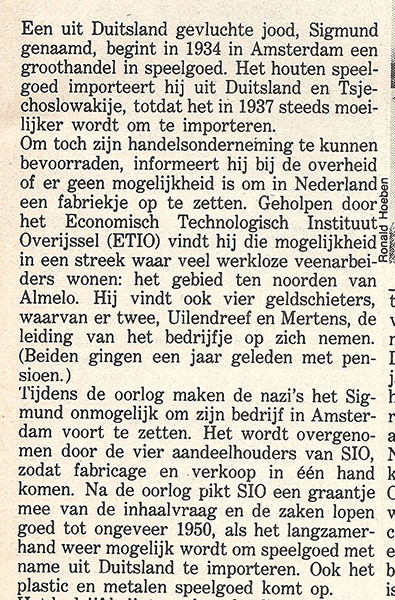
The importance of Mr. Sigmund's contribution to the establishment of Sio is mentioned in an article from HP De Tijd dated February 10, 1979. It states:
In order to supply his trading company, he inquires with the government whether there is any possibility to establish a small factory in the Netherlands. Assisted by the Economic Technological Institute Overijssel (ETIO), he finds that opportunity in an area where many unemployed peat workers live: the region north of Almelo. He also finds four financial backers, two of whom, Uilenreef and Mertens, take on the management of the company.
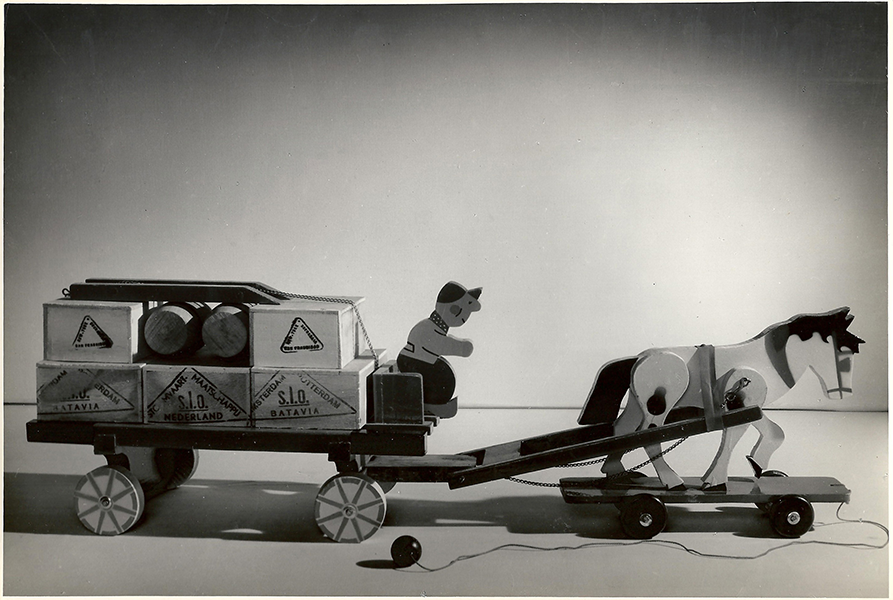
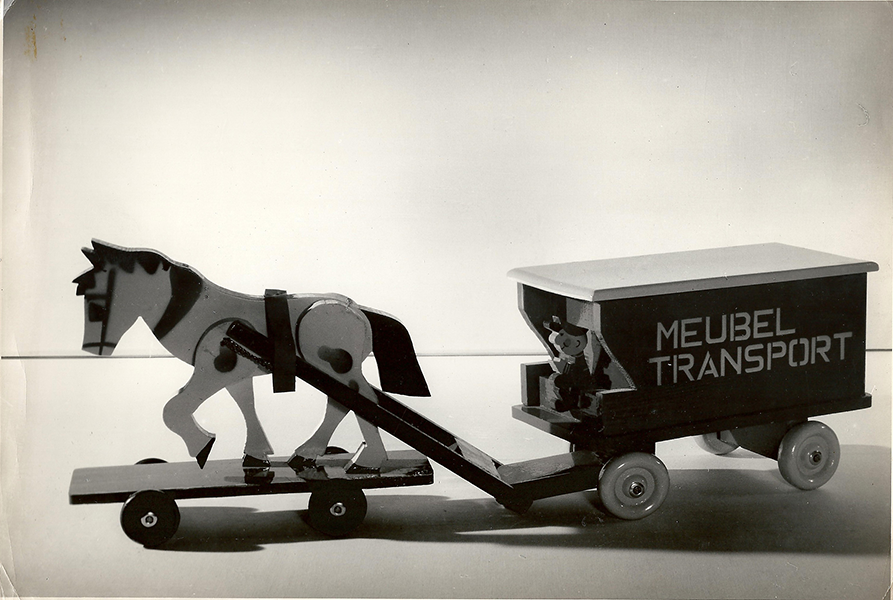
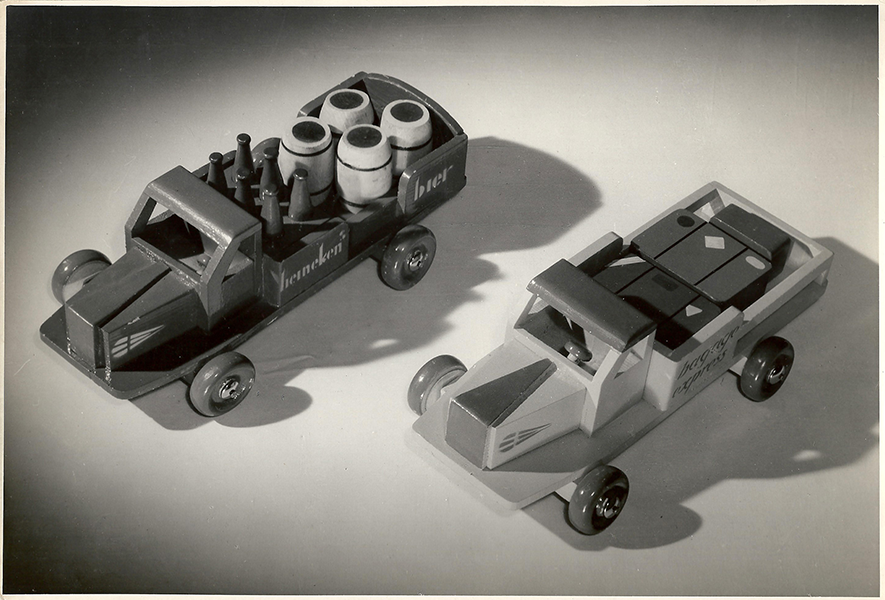
Jantje van Alles
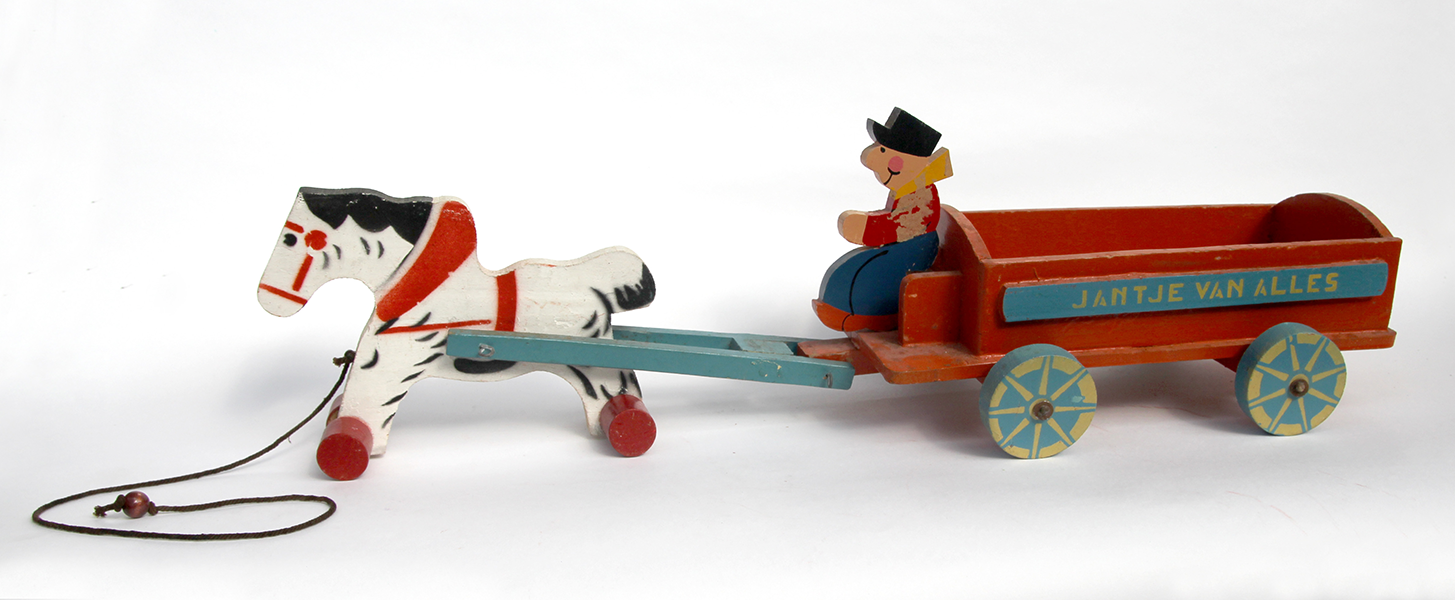
From the establishment of Sio until the early 1950s, designs by the Sigmund couple were produced by Sio. Several horse and carriage combinations featured 'Jantje van Alles' (Jack of Everything) on the driver's seat. The painting (fine painting) of Jantje couldn't be done at the factory. It was done by a painter at home, where the Sigmund family lived. The painter continued to paint Jantjes until the 1950s and regularly delivered them to the factory in Vroomshoop.
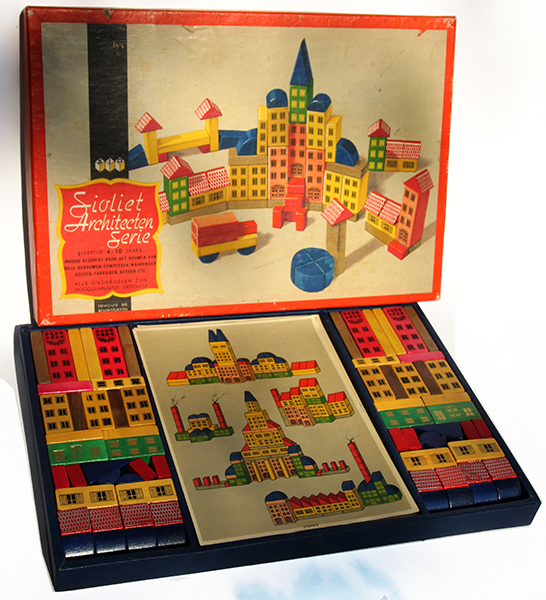
The Sioliet block set is a copy of the Schowanek construction sets, which could no longer be imported later.
Sioliet
The coloring of wood in rotating drums began in the late 1920s. Several toy companies, such as Schowanek, were involved in this, and various patents were granted at that time, including to L. Engel and E. Reuter in Blumenau.
Large drums (initially made of wood, later stainless steel) containing the wooden parts were rotated. To polish the parts, pumice stone was first used.
Due to the movement of the drums, the parts pressed the color into the wood. It was important that both large and small wooden parts were colored simultaneously so that the color could reach into every small corner.
Polishing with pumice rounded the corners of the parts. Furthermore, the coloring made the surface very smooth. As a result, smaller building blocks, in particular, were difficult to stack.
This method of coloring was later greatly improved by Sio. It was always kept very secret at the factory. No photographs were allowed to be taken.